I Didn’t Want Another AI Chatbot. I Wanted to Understand How AI Teams Work.
Product Forge AI is an AI-powered product-planning workspace that turns a raw idea into a structured proposal in under two minutes. It coordinates specialists across market, product, UX, architecture, data, security, delivery, metrics, and risk, then validates and synthesizes their work into one coherent plan.
The idea behind Product Forge AI did not begin with a product-planning problem. It began with a learning question:
What changes when an AI system stops behaving like one assistant and starts operating like a coordinated team?
Large language models are remarkably capable generalists. Give one model a product idea and it can produce market analysis, requirements, architecture, user stories, risks, and a roadmap. But asking one model to do everything often creates the illusion of completeness. The answer may be polished while its assumptions conflict, its terminology drifts, or important disciplines receive only superficial attention.
I wanted to explore a different model: not one prompt that asks for everything, but an orchestrated system in which specialized agents work in parallel, communicate through defined contracts, and contribute to a shared outcome.
Product Forge AI became the laboratory for that exploration.
The Product Is a Means to Study the System
The user experience is intentionally simple: describe a product idea—“Airbnb for boats,” for example—and receive a production-oriented proposal containing market context, competitors, personas, requirements, architecture, data models, APIs, security concerns, delivery phases, KPIs, and risks.
Behind that experience, however, is the real subject of the project.
An orchestrator decomposes the request and delegates work to specialists: market research, product management, UX, architecture, database design, API design, security, delivery planning, metrics, and risk. Independent tasks fan out and run concurrently. Their results then fan in to a synthesis stage, where they are reconciled into one coherent proposal.
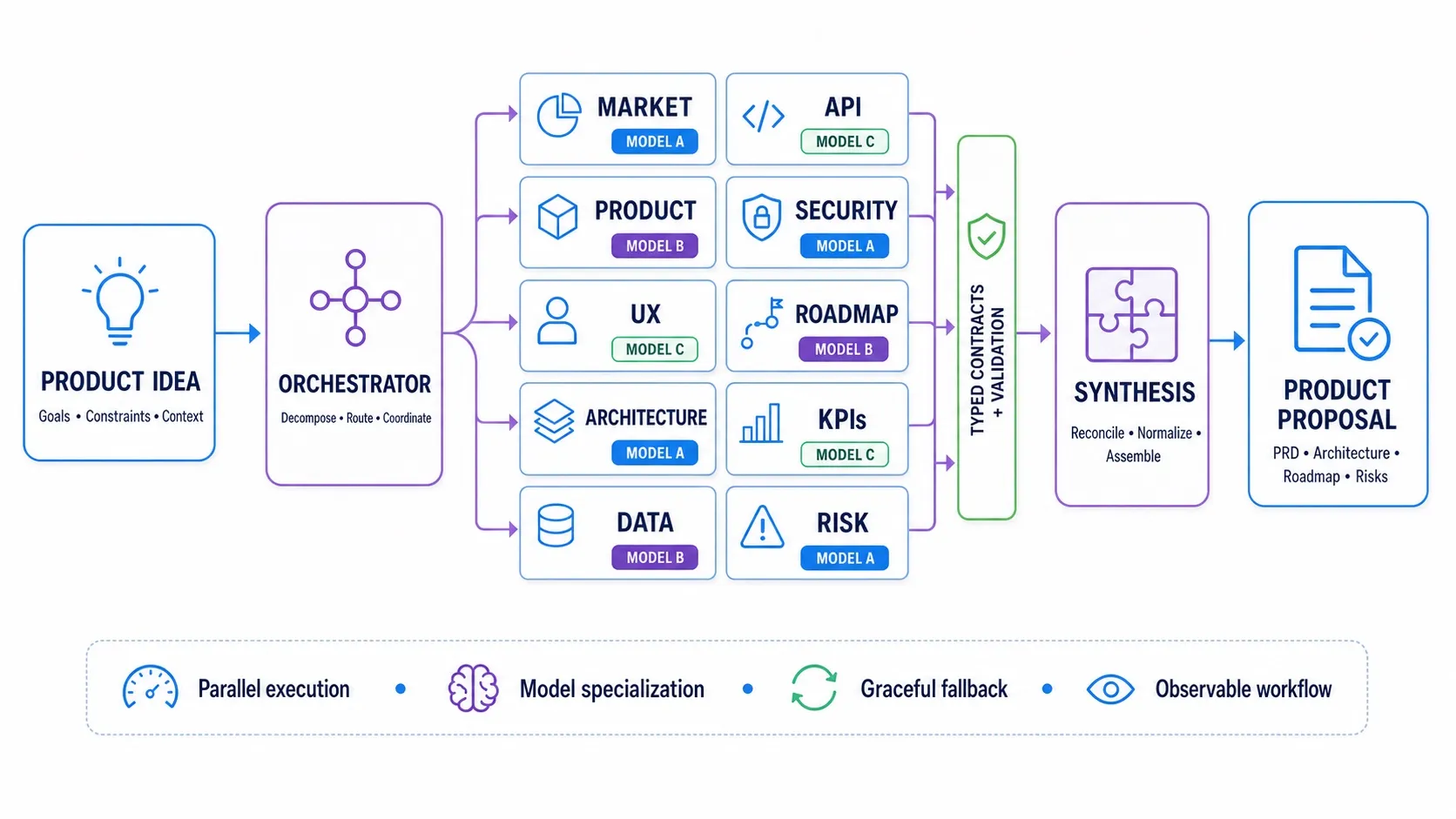
This is not simply several prompts executed at once. Orchestration introduces a new class of engineering concerns:
- Which work can run independently, and which work has dependencies?
- What context does each specialist actually need?
- How should agents exchange results without ambiguity?
- What happens when one output is malformed, incomplete, or unavailable?
- How do we preserve consistency across separately generated artifacts?
- How can a person understand what the system did and why?
Those questions are where multi-agent systems become much more interesting than chat interfaces.
The Most Important Lesson: Coordination Is the Product
Adding more agents does not automatically produce better results. Without coordination, it can produce more inconsistency at greater cost.
The value comes from the system around the models.
Each Product Forge specialist returns structured data rather than free-form prose. Typed contracts define what an agent must produce, and validation prevents malformed output from silently contaminating later stages. Dependencies are explicit. Independent work runs in parallel to reduce latency. Retries and domain-specific fallbacks allow the workflow to finish even when one specialist fails. The synthesis agent is responsible not for inventing another answer, but for resolving overlaps, maintaining terminology, and assembling the validated contributions.
The architecture also allows each specialist to use a different model. Models can be matched to a task’s domain, reasoning needs, latency, or cost instead of forcing every agent onto one platform-wide choice.
That design reflects a broader principle: reliable AI applications depend less on a perfect prompt and more on clear boundaries, controlled handoffs, and observable execution.
In organizational terms, this should sound familiar. A high-performing team is not created merely by hiring more experts. It requires roles, interfaces, sequencing, shared definitions, escalation paths, and someone accountable for integration. Multi-agent architecture turns those management principles into software design.
Making the Invisible Visible
One goal of Product Forge AI is to expose the orchestration rather than conceal it behind a typing indicator.
The interface visualizes the execution graph. Users can see which specialists are running, which have completed, where failures occurred, how long stages took, and what can be retried. This is more than visual polish. It creates trust through inspectability.
For executives, that visibility answers: “Where did this recommendation come from, and how dependable is it?”
For principal engineers, it exposes the operational questions: “Which node failed? What contract was violated? Can we rerun only the affected branch? What downstream artifacts must be regenerated?”
As AI systems take on longer and more consequential workflows, observability will not be optional. A final answer alone is insufficient; teams will need lineage, validation status, failure context, and a record of how the outcome was assembled.
What This Changes for Technical Leadership
Multi-agent orchestration offers a practical way to encode how an organization approaches complex work. It can separate concerns, parallelize analysis, introduce review stages, and make policy part of the workflow rather than a sentence buried inside a prompt.
It also forces important architectural discipline. Model output must be treated as untrusted input. State must survive individual execution failures. Cost and latency must be designed, not discovered. Deterministic workflow logic must surround probabilistic reasoning. Human approval should appear at high-impact decision points rather than being added as an afterthought.
The result is not autonomous “digital employees.” A more useful framing is a software system composed of bounded reasoning capabilities, each operating within an explicit responsibility.
Extrapolating the Principles Beyond Product Planning
The same orchestration pattern applies anywhere a complex outcome benefits from multiple perspectives and controlled handoffs:
- Incident response: agents can inspect telemetry, recent deployments, dependencies, and known failure patterns in parallel before an incident lead reviews a synthesized diagnosis.
- Software delivery: separate agents can analyze requirements, propose an implementation, review security, generate tests, and validate documentation through an explicit dependency graph.
- Enterprise research: specialists can evaluate market, financial, regulatory, technical, and competitive evidence while preserving citations and surfacing disagreements.
- Customer operations: agents can classify an issue, retrieve account context, check policy, propose a resolution, and route sensitive decisions to a person.
- Compliance and risk: independent reviewers can test a proposed action against different policy domains, with every conclusion linked to its source and validation state.
- Strategic planning: scenario, finance, operations, and risk agents can develop parallel views that are reconciled into decision options rather than compressed prematurely into one answer.
The transferable pattern is consistent: decompose the outcome, assign bounded responsibilities, define contracts, model dependencies, validate every handoff, design for partial failure, expose the execution, and reserve human judgment for decisions that deserve it.
The Real Opportunity
Product Forge AI may generate product proposals, but its deeper purpose is to explore a shift in application architecture.
The next generation of useful AI systems will not be defined only by stronger models. They will be defined by how intelligently we organize those models around work: how we constrain them, connect them, verify them, recover from failure, and keep people meaningfully in control.
The most interesting question is no longer, “What can one model answer?”
It is, “What can a well-orchestrated system accomplish reliably?”
Try Product Forge AI live with your own idea, or explore the source on GitHub to see how the orchestration works.