How to price your product
Why does a plane ticket cost more every time you refresh the page? (And what your business can learn from it)
Book a flight three months out, then check the same flight again next week, and again the week after that. The price moves — sometimes up, sometimes down — without a single person retyping a number. That’s not random, and it’s not a trick. It’s a well-understood branch of math called revenue management, and airlines have been running on it since the 1990s. I built a small, open-source, interactive tool that shows exactly how it works — and the underlying idea turns out to apply far beyond airplanes.
The problem, in plain terms
An airline seat has one brutal property: the moment the plane pushes back from the gate, every empty seat becomes worth exactly nothing. You can’t put it in a warehouse and sell it next month like a sweater. It just evaporates.
At the same time, not every customer values that seat equally. A family booking a vacation four months out will happily take a cheaper fare and a worse time slot. A businessperson who has to be in another city tomorrow morning will pay much more for the same seat, booked much later.
Put those two facts together and you get a real dilemma:
- Price too low, too early, and you sell out the plane with vacationers months in advance — then have nothing left to sell to the last-minute business travelers who would have paid double.
- Price too high, too rigid, and the plane takes off half full, and every one of those empty seats’ potential revenue is gone forever.
A single fixed price can’t solve this. You need a system that constantly asks: given how many seats are left, and how much time is left before departure, what’s the right price to charge right now?
The four ideas that make it work
Strip away the statistics and the model comes down to four ideas anyone can follow:
1. Different customers, different segments. Don’t treat all demand as one blob. Leisure travelers and business travelers respond to price differently and book at different times — model them separately instead of guessing at one average customer.
2. Protect what’s scarce for the customer who hasn’t shown up yet. This is the counterintuitive part: sometimes the right move is to refuse to sell a seat cheaply today, because the math says a higher-paying customer is likely to want it later. This is exactly what airlines mean when they “hold back” seats in a fare class.
3. Keep checking your work as reality unfolds. The plan you make three months before departure shouldn’t be the plan you’re still following the day before. As bookings actually come in, the system re-checks itself again and again, and adjusts the price to match how the flight is really filling — not how it was expected to fill.
4. Never let the math run wild. A price floor (never sell below what it costs you), a price ceiling (never gouge), and a limit on how much the price can jump at once. These are guardrails a human sets — the algorithm just enforces them, every time, without getting tired or making an exception for the wrong reason.
That’s it: segment demand, protect scarce inventory for higher value later, re-optimize continuously, and stay inside guardrails. The actual technique behind step 2 — called EMSRb — is 35-year-old, well-validated statistics, not some black-box AI. It’s explainable, auditable, and it’s been running quietly behind almost every plane ticket you’ve ever bought.
This isn’t just about planes
Once you see the pattern, you start noticing it everywhere. The core ingredients — something perishable, uneven demand, and a finite window to sell it in — show up across a surprising number of industries:
- Hotels and short-term rentals. An empty room tonight is gone forever the moment midnight passes. Same math, different seat.
- Live events and concerts. An unsold seat at a show has zero value the second the curtain goes up.
- Cloud computing capacity. Unused server capacity this minute can’t be banked and sold next minute — which is exactly why cloud providers price spot capacity dynamically.
- Ride-sharing. “Surge pricing” is the same demand/supply rebalancing act, just recalculated in real time instead of over months.
- Advertising inventory. An ad slot that doesn’t sell before the page loads is gone — impressions are perishable inventory too.
- Seasonal retail. Not identical, but the same tension: hold price and risk unsold stock at season’s end, or discount and leave money on the table with customers who’d have paid full price.
If your business has scarce capacity, a deadline after which unsold inventory is worthless, and customers with different willingness to pay — you likely already have a revenue-management problem, whether or not you’ve named it that.
Seeing it, not just reading about it
Reading about this is one thing; watching the price curve reshape itself the instant you move a slider makes it click. That’s why I built Flight Pricing Studio — a free, open-source, interactive demonstration of this entire model, running live in the browser.
Try it: Flight Pricing Studio
You can drag the sliders — capacity, demand mix, price sensitivity, how far out people book — and watch the price curve, the load-factor curve, and the expected revenue recompute instantly. There’s also a Monte Carlo simulator that stress-tests the pricing policy against thousands of randomized demand scenarios, and a validation exhibit comparing the dynamic policy against a single flat fare across ten synthetic route types. It wins by roughly 4–5% on average, with the gap widest on price-sensitive leisure routes and smallest on business-heavy ones — exactly what the theory predicts.
Here’s the key architectural choice: one shared pricing engine runs identically in the browser and on the server, so there’s never a mismatch between what the interface shows and what the API would actually quote.
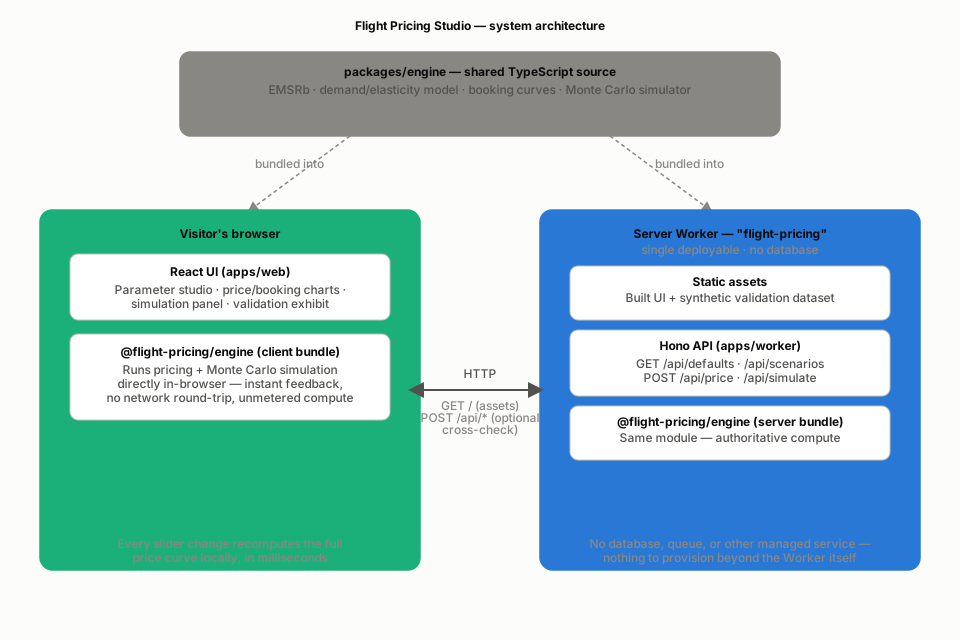
Everything — the pricing engine, the simulator, and the technical write-up — is open source.
Try the live demo or browse the source code on GitHub.
Poke around, break it with extreme inputs (it’s designed not to crash), or just watch what happens to the price curve when you make business travelers a bigger share of demand.
All figures and data in the tool are synthetic and illustrative — not real airline fares, schedules, or revenue.